What the Commission proposed
The text is referenced COM(2026) 1100 ((new tab)). It is a proposed regulation that would repeal Directive 2005/29/EC on unfair commercial practices. Under its Article 39, it would apply twelve months after entry into force.
Watch outIt is still only a proposal. The European Parliament and the Council have to adopt it, and the text may change before then. The components involved are few, so you may as well review them before adoption.
The ten dark patterns on the list
Article 10 bans designing an interface in a way that deceives or manipulates consumers. Part III of Annex I (points 53 to 62) lists ten dark patterns regarded as unfair in all circumstances, and the Commission could extend the list through delegated acts. The table sums them up, with the components of your library where I see them most often.
| Point | Banned practice | Components to review |
|---|---|---|
| 1 | Falsely claiming that a product is scarce or popular, or hiding the conditions behind the claim | Stock badge, popularity banner |
| 2 | Showing scarcity or popularity messages throughout the ordering process | Popularity banner, checkout flow |
| 3 | Using pre-selected options the user must reject to avoid paying for something extra | Paid-option checkbox |
| 4 | Presenting declining a purchase, or ending a subscription, as the wrong choice | Decline button (“No thanks, I’d rather pay more”), retention modal |
| 5 | Suggesting that the highlighted option is the only one | Button group, offer card |
| 6 | Repeatedly asking for a choice already made, when the law does not require it | Consent modal and banner |
| 7 | Wording choices in a misleading or ambiguous way, with reversed logic or double negatives | Double-negative checkbox (“Don’t unsubscribe me”), choice labels |
| 8 | Showing the price, contract length or automatic renewal less prominently than other information | Offer card (recurring price in small print under the promotional one) |
| 9 | Sending notifications that falsely suggest someone contacted the user or that something needs their attention | Notification, notification badge |
| 10 | Making it disproportionately longer or harder to refuse, withdraw or change a choice | Cancellation journey, account settings |
Cancellation, under Article 23
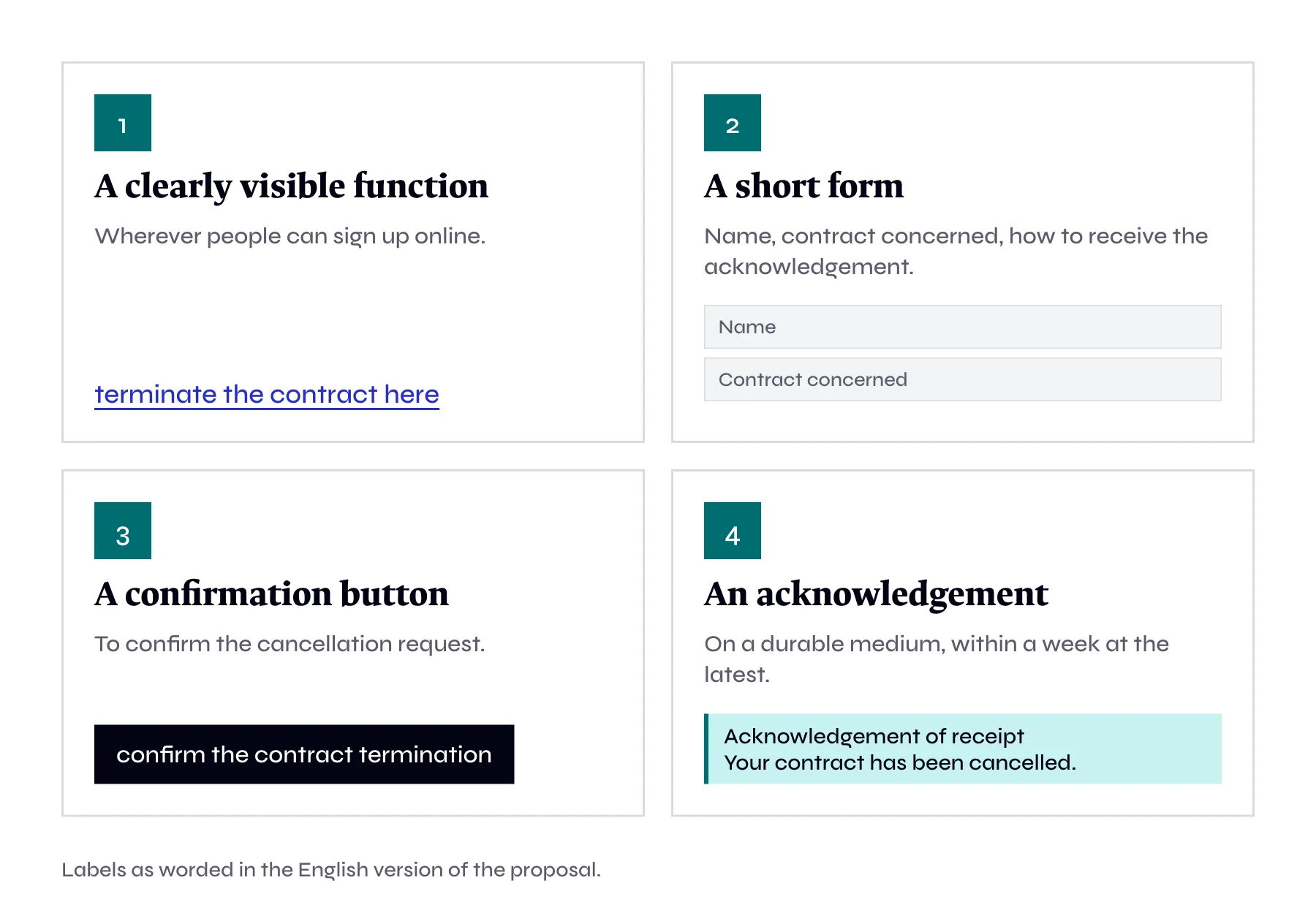
Point 10 also covers overly long cancellation journeys, and Article 23 adds a dedicated obligation. Where a business lets consumers sign contracts online, it must provide an online cancellation function, prominently displayed and easy to reach. It is labelled “terminate the contract here” or an unambiguous equivalent.
terminate the contract here
It leads to a form (name, contract concerned, how to receive the acknowledgement), then to a “confirm the contract termination” button. The business then sends an acknowledgement on a durable medium, within a week at the latest.
TipIf your product serves France, part of this already exists. Since 1 June 2023, Article L. 215-1-1 of the French Consumer Code ((new tab)) has required a “résilier votre contrat” (cancel your contract) function for contracts concluded electronically. The Digital Fairness Act would extend the principle across the EU and spell out the steps in more detail.
What I suggest you do now
Audit your design system
0 of 5
Frequently asked questions
No. It is a proposed regulation: the European Parliament and the Council have to adopt it, and the text may change before then.
Under its Article 39, twelve months after entry into force.
It would repeal Directive 2005/29/EC on unfair commercial practices.
A clearly visible function, a form (name, contract concerned, how to receive the acknowledgement), a confirmation button, then an acknowledgement on a durable medium, within a week at the latest.
Since 1 June 2023, Article L. 215-1-1 of the French Consumer Code has required a “résilier votre contrat” (cancel your contract) function for contracts concluded electronically.